Japan's NICT shrank picosecond time sync into a phone-sized box. They call it Wi-Wi.
NICT's Wi-Wi prototype hit 30 ns time sync with 20 ps jitter at 900 MHz. It isn't Wi-Fi. Jeff Geerling found a working demo at the NAB show.
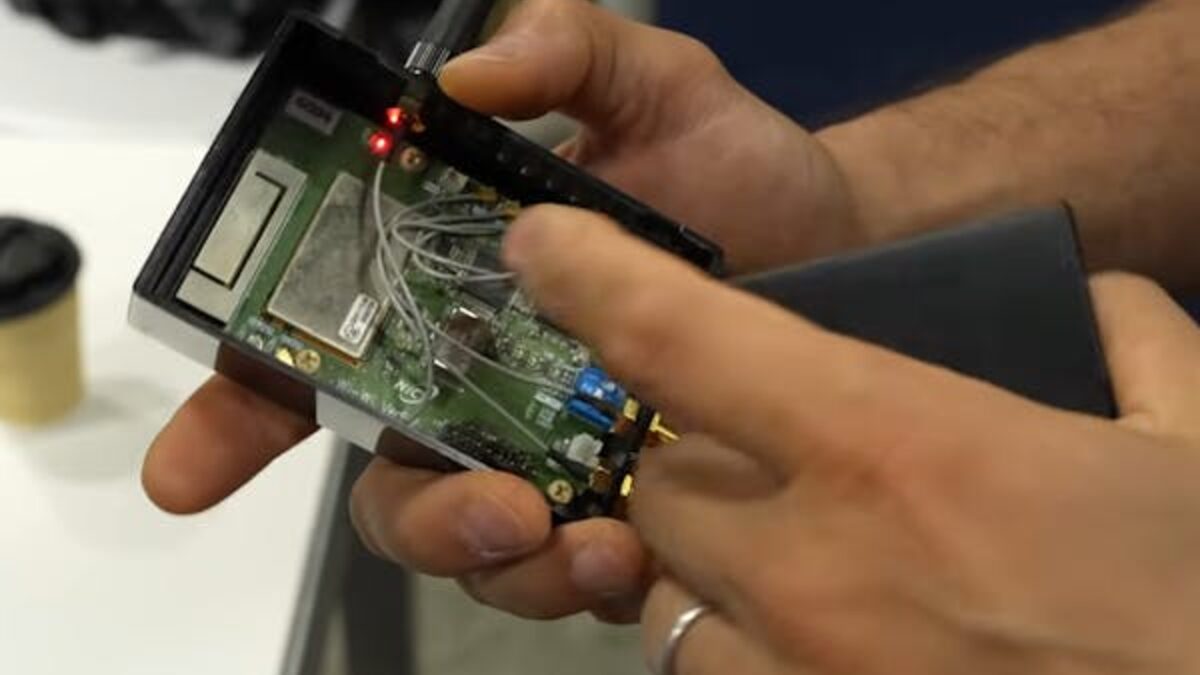
Japan’s National Institute of Information and Communications Technology is running a small radio system, called Wi-Wi, that syncs clocks wirelessly to roughly 30 nanoseconds. Jeff Geerling filed a write-up after seeing the prototype demo at NAB. The current module is about the size of a phone. The target spec is single-digit nanoseconds.
The name reads like a play on Wi-Fi. The technology isn’t. Wi-Wi stands for “Wireless two-Way interferometry,” and it’s a stripped-down version of the two-way satellite time transfer national timing labs use to keep atomic clocks aligned across continents. NICT scaled that idea down to a 900 MHz RF box that fits on a workbench.
What the demo actually does
Wi-Wi sends precisely timed signals from a transmitter to a receiver and uses the round-trip to derive both time and distance. The published prototype numbers from NICT, as of March 2024 reporting and confirmed by Hackster.io’s recent demo coverage, are roughly 30 ns of time sync and about 20 ps of phase jitter. The next-generation hardware is aimed at sub-5 ns time sync in operational use. The setup needs three or more transmitting devices producing identical 900 MHz waveforms; the receiver compares phase across them and pulls out its 3D position to millimetre accuracy as a side-effect.
A few specifics matter when comparing this to existing time-sync stacks.
- PTP needs cables. IEEE 1588 Precision Time Protocol is the data-centre and broadcast standard for sub-microsecond accuracy, and it runs over Ethernet. Wi-Wi delivers comparable precision without the cable run, which is the part nobody else has shipped at this size.
- GPS hits a wall indoors. GPS-disciplined oscillators are the usual fallback for wireless timing, but they require sky view and degrade fast inside buildings or near interference. Wi-Wi works in the same room as your transmitter.
- NTP isn’t in the same league. Network Time Protocol is millisecond-class on a good day. Wi-Wi is six orders of magnitude tighter.
The Wi-Wi STAMP variant Geerling demoed is the package NICT is showing to industry. The module is currently smartphone-sized; the broadcast and manufacturing applications NICT cites as design targets all care about getting that smaller and cheaper. There’s no public price tag and no commercial product yet. The technology is in late-stage research, with engineering samples on demo floors.
Why this is suddenly visible
Time sync has been quietly creeping up the priority list for several adjacent industries. 5G base stations need tighter-than-PTP synchronization to coordinate spectrum across cells. Broadcast trucks at events like NAB run dozens of cameras that must phase-align frame-accurately, today over fiber. Manufacturing lines coordinating robot arms hit the same ceiling. All three have wireless deployment goals that have been gated on the lack of a sub-microsecond wireless time source.
Wi-Wi is the first credible demo of one. The fact that NICT is showing it at NAB instead of an academic conference is the signal that’s worth tracking. NICT is a research lab, but its standards work historically feeds Japanese industry partners who then push for ITU and IEEE adoption. If Wi-Wi reaches an interop specification, the path from prototype to telco-grade deployment shortens dramatically.
The open question is whether 900 MHz is a viable production band. The spectrum is regulated and crowded in most countries, and a working Wi-Wi rollout would need either licensed allocation or a fight over unlicensed slots. NICT’s own Wi-Wi research page lists the band as a research choice. Whether it survives commercialization is a separate question from whether the precision is real.
What this means for you
If you’re a broadcast or live-events engineer, this is the line item to put on next year’s vendor briefing list. NAB demos historically don’t ship for a year or two, but the precision Geerling measured is already within striking distance of what camera-sync rigs need, and the wireless form factor genuinely changes what’s possible on a multi-camera shoot.
If you’re a developer further from the timing pipeline, it’s still worth knowing that PTP-class accuracy is leaving the cable. The next generation of distributed systems, edge AI clusters, and consumer mesh networks will eventually have access to nanosecond timing without a wired sync island, and the assumptions distributed-systems textbooks were built on (clocks drift; synchronization is expensive) will start to relax. Slowly, then all at once.
Share this article
Quick reference
Sources
- Wi-Wi is wireless time sync at 1 nanosecond — Jeff Geerling
- Wi-Wi Stamp Syncs Time Wirelessly in a Nanosecond — Hackster.io
- Wi-Wi: Wireless two-Way interferometry — NICT